Artificial intelligence in companies in Rome and Rieti: training employees and optimising processes
How to bring artificial intelligence into an SME in Rome or Rieti without wasting budget: employee training (also a legal obligation since 2025), processes to automate first, costs, grants and a 90-day programme.
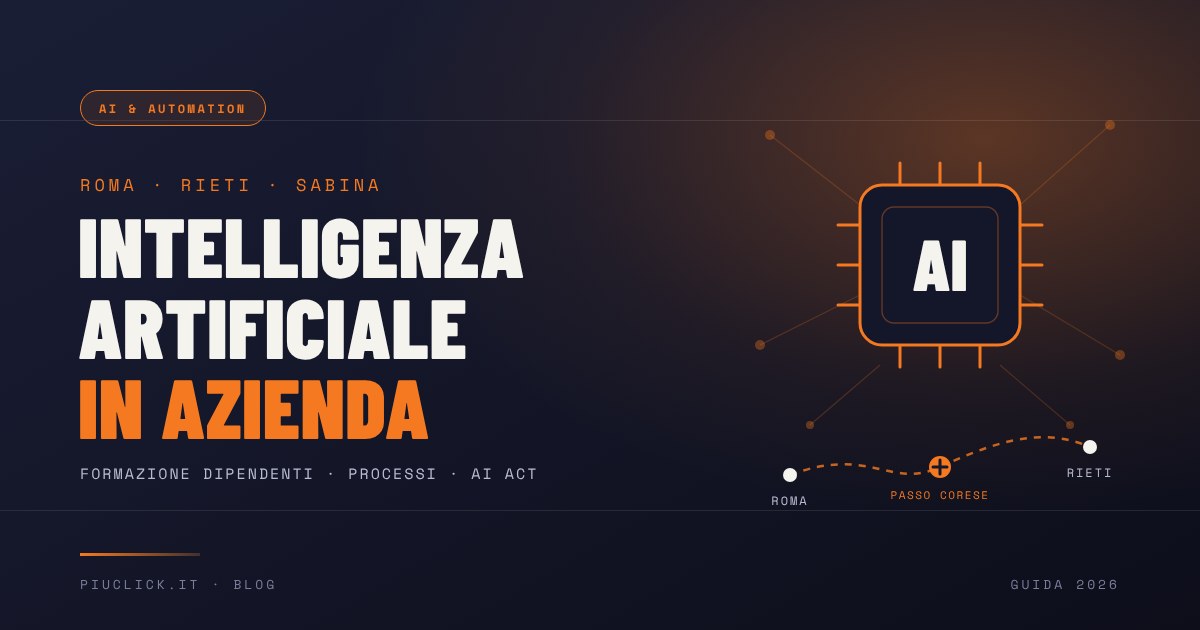
Between Rome and Rieti, the question companies ask has changed. A year ago it was: "Is AI relevant for us too?". Today it is more concrete, and more uncomfortable: "Half my staff already use ChatGPT on their phones, and I don't know what for or with which data. How do I bring order to this and get a real advantage out of it?".
This guide answers with a method, not a list of tools. It explains what bringing AI into an SME really means, how to explain it to employees (and why since 2025 it is also a legal obligation), which processes to optimise first, what it costs and which grants are available today to businesses in Rome, Rieti and Sabina. We wrote it from Passo Corese, where +Click is based, halfway between the two cities.
What bringing artificial intelligence into a company actually means
Bringing artificial intelligence into a company means putting AI tools into everyday work in a governed way: people trained to use them, clear rules on data and responsibility, processes redesigned where AI saves time or errors, and numbers that tell you whether it was worth it. It is not software you install: it is an organisational change with a technology component.
For an SME there are three levels, and it almost always pays to climb them in this order:
- AI assistants for individual work. ChatGPT, Claude, Gemini or Copilot, used by each person to write, summarise, translate and analyse documents. They are cheap and the effect is immediate, but only with training and rules: without them, everyone improvises and company data ends up in personal accounts.
- AI inside processes. AI is connected to the tools the company already uses (email, CRM, management software, WhatsApp, calendar) through automations: a request comes in, the AI reads it, classifies it, drafts the reply or extracts the data, and a person approves. This is where the real hours are recovered.
- Custom solutions and agents. Assistants that know the company's procedures and documents, agents that carry out multi-step tasks, management software and apps with AI built in. They make sense once the first two levels work and the data is in order.
Rome, Rieti and Sabina: where businesses stand
The most recent national data comes from the Istat "Enterprises and ICT" 2025 survey, published in December 2025. It shows adoption accelerating, but at two speeds.
One figure matters more, though. Among companies that considered an AI investment and then did not make it, almost six in ten cite a lack of adequate skills as the obstacle. The problem is not cost and not technology: it is people. That is why in this guide training comes before tools.
Locally, the problem takes different shapes:
- In Rome, services, professional firms, retail, tourism and public-sector suppliers dominate: businesses that run on documents, email and paperwork. Here AI pays off mostly in handling requests, producing documents and customer service. And with so much competition, time saved quickly becomes an advantage.
- In Rieti and Sabina, small manufacturing, food, craft, automotive and tourism businesses dominate, often with few employees and an owner who also handles the admin. The Passo Corese logistics hub and the Rieti-Cittaducale industrial area add orders, transport documents and shifts to coordinate. Here every hour recovered weighs more, because there is rarely a dedicated person to delegate to.
- In both cases, staff already use AI, often with personal accounts and no rules. Before adding tools, it pays to know what is already happening.
Explaining AI to employees: a legal obligation and an adoption lever
Explaining artificial intelligence to employees serves two purposes: getting it used well, and getting it used at all. Since 2025 it is also a regulatory matter, and it is worth knowing precisely, without alarmism.
What the AI Act requires (Article 4)
Since 2 February 2025 the AI Act, the EU regulation on artificial intelligence, has required providers and users of AI systems to take care of the AI literacy of their staff and of anyone using those systems on their behalf. In July 2026 Regulation (EU) 2026/1744, the so-called Digital Omnibus on AI, rewrote Article 4. Today the obligation is to take measures to support the development of AI literacy, tailored to people's knowledge, experience and context of use, without having to guarantee a specific level for each individual.
For an SME this means: the obligation still exists, it is more reasonable than it was often made out to be, and it is met with concrete, documented initiatives. No certification is needed, and according to the European Commission's guidance an internal record of training and support activities is enough. Those activities must exist, though, and be proportionate to how the company uses AI.
What Italian Law 132/2025 requires
Law no. 132 of 23 September 2025, in force since 10 October 2025, is Italy's first law on artificial intelligence. Article 11 covers work. AI must be used to improve working conditions and productivity, in a safe, reliable and transparent way, without harming people's dignity and privacy. When AI systems affect the management of the employment relationship (recruitment, task assignment, evaluation, monitoring), the employer must inform workers under Article 1-bis of Legislative Decree 152/1997, the so-called Transparency Decree.
How we structure AI training for employees
Training that works is not a generic course on "what ChatGPT is". It is a short programme, built on each department's real tasks, that leaves rules, examples and go-to people inside the company. This is how we set it up:
- Role map: who already uses AI, for what, with which tools and which data. So-called "shadow AI" often surfaces here, meaning tools used quietly with personal accounts. It should not be punished: it should be brought into the open and governed.
- A baseline session for everyone, two to three hours long: how a language model works, what it can and cannot do, hallucinations, which data must never be entered, how to check an answer. This is the part that addresses Article 4 of the AI Act.
- Department labs: admin, sales, marketing, customer service, production and logistics work on their own documents and emails, not on made-up examples. Everyone leaves with prompts and procedures ready to use.
- A company AI policy of one or two pages: approved tools, forbidden data, mandatory human review for everything leaving the company, how to report a problem.
- Internal champions: one or two people per department become the go-to reference, collect what works and keep the prompt library up to date.
- Training log: dates, content, participants. This is the documentation that shows the AI literacy measures taken.
In the labs, each department works on tasks like these:
- Admin: checking invoices, payment reminders, extracting data from documents, replying to suppliers.
- Sales: drafting offers and quotes, summarising calls, follow-ups.
- Marketing: content drafts, product sheets, replies to reviews, reading campaign data.
- Customer service: answers to recurring questions, routing requests, translations.
- Production and logistics: clear work instructions, minutes, checklists, reading delivery notes and orders.
- Management: report summaries, meeting preparation, comparing scenarios.
The goal is not to turn everyone into an expert. It is to make sure nobody uses AI blindly and that everyone has at least two or three tasks where they use it productively every week. From that point on, adoption keeps going on its own.
Which processes to optimise with AI (and which to leave alone)
A process suits AI when it has four traits: it repeats often, it works on text or documents, it follows rules you could explain to a new colleague and, if the AI gets it wrong, the error is caught before it does damage. The more traits are missing, the riskier the project. These are usually the processes to start with:
- Incoming requests: emails, website forms and WhatsApp messages read by AI, classified by type and urgency, with a draft reply waiting for approval. It is the most common case and the one that pays back first.
- Quotes and offers: from the customer's request to a tidy draft quote, with prices taken from the price list, not invented.
- Incoming documents: invoices, delivery notes, orders, certificates. AI extracts the data and loads it into the management software, and a person only checks the exceptions.
- Reminders and follow-ups: appointments, deadlines, quotes left unanswered. On Social AI Hub, the AI-powered management platform we develop, businesses that switch on automatic WhatsApp reminders cut no-shows by up to 70%.
- First-line customer service: a chatbot or assistant answers recurring questions based on the company's documents and hands everything else to a person.
- Internal knowledge: an assistant answers employees' questions on procedures, manuals and price lists. It is extremely useful for new hires and in companies where everything lives in two people's heads.
- Content and marketing: product sheets, newsletters, posts, replies to reviews. AI prepares quick drafts, then someone who knows the customer reviews them.
How to work out whether it pays
The maths is simple and should be done before you start: hours saved times hourly cost, minus the cost of tools, setup and maintenance. Here is a worked example, not an average figure. Three people each recovering four hours a week, over 46 working weeks and at a company cost of €25 an hour, are worth €13,800 a year. If the project costs €5,000 across licences, training and automations, the balance is positive in the first year. If the hours recovered are half that, it still pays, but you need to know it beforehand rather than find out afterwards.
Beyond time, measure the effects time alone does not show: speed of response to customers, quotes closed, data-entry errors, missed appointments.
The 90-day method: from the first workshop to an automated process
Ninety days are enough to go from scattered experiments to a measured result on at least one process. This is the programme we propose to companies in Rome and Rieti, in four phases:
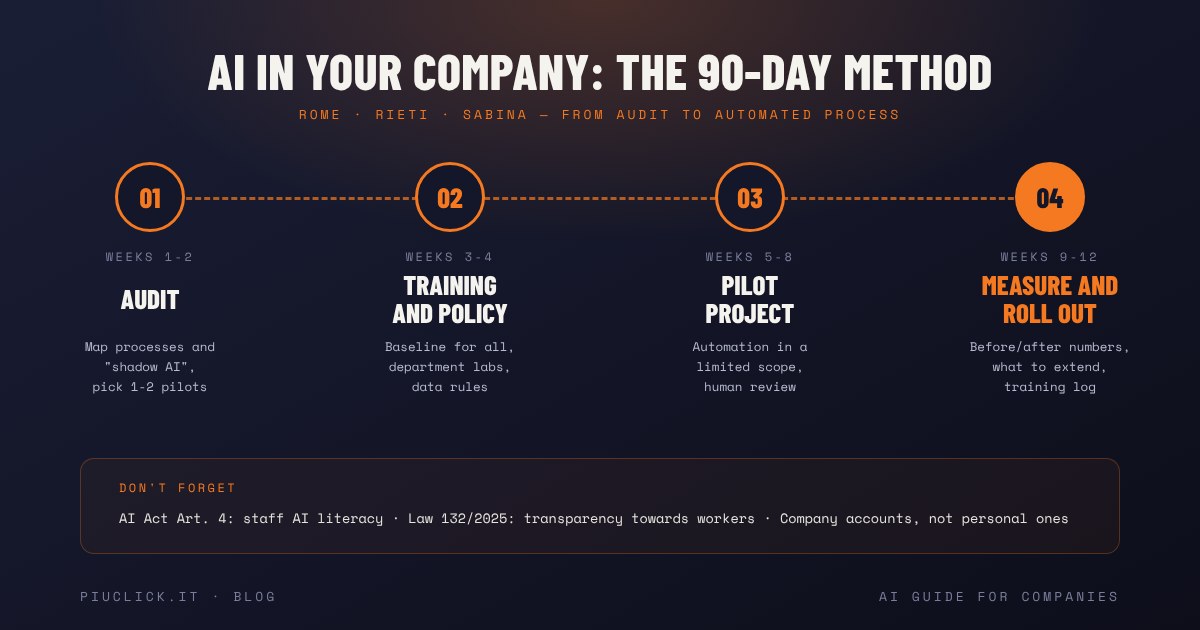
- Weeks 1-2, audit: interviews with departments, process map, list of AI tools already in use. One or two pilot processes are chosen with a numeric target, for example halving response time to requests.
- Weeks 3-4, training and policy: baseline session for everyone, labs for the departments involved, AI policy approved by management, company tools and accounts set up.
- Weeks 5-8, pilot project: the automation is built and put into use within a limited scope, with a person checking every result. Cases where it gets things wrong are collected and fixed.
- Weeks 9-12, measurement and roll-out: comparison with the starting numbers, a decision on what to extend, documentation for the company and for the training log.
We choose the tools after the audit, not before. For automations we often use n8n and Voiceflow, connected to the AI models best suited to the task and to the systems the company already uses. If a process needs a dedicated tool we build it, as we did with our own platforms: we tell that story in the Social AI Hub app case.
What bringing AI in costs, and which grants exist in Rome and Rieti
The cost of an AI project in an SME has four items. Keep them separate, because they behave differently:
- AI assistant licences. Business plans for ChatGPT, Claude, Gemini or Copilot cost roughly €20 to €35 per user per month (price lists change often and should be checked). Unlike personal plans, they exclude the use of your data for model training and let the company manage accounts centrally.
- Training. Paid per session or per day, it is the item with the highest return, because it decides whether the licences will actually be used.
- Building automations. A one-off cost that grows with the number of systems to connect and cases to handle, plus light maintenance.
- Model usage costs. Automations pay for models on a usage basis. For SME volumes these are often modest amounts, but they should be estimated during the audit.
Part of the cost, especially training, can be funded. These are the main routes for businesses in Lazio. Calls and deadlines change often, so we check them case by case during the audit.
- Inter-professional training funds. Member companies can fund employee training through their own training account. Fondimpresa, the largest fund, ran a call dedicated to artificial intelligence (Call 4/2025: €5 million, applications between February and May 2026). It is worth following the next editions and checking your account balance.
- Chamber of Commerce vouchers. The Punto Impresa Digitale network has allocated €150 million for 2026-2029 to the Twin Transition Voucher, covering up to 70% of costs with an explicit focus on artificial intelligence. Each Chamber publishes its own call. The Rome Chamber of Commerce opened its call in September 2026, with base grants of up to €10,000. For businesses in the Rieti area the reference is the Rieti-Viterbo Chamber of Commerce. The usual first step is a free digital maturity self-assessment on the PID portal.
- Lazio Region. Lazio Innova periodically publishes digitalisation vouchers for SMEs, funded by the ERDF 2021-2027 programme. Check whether the new edition covers AI and automation projects.
Why choose a partner between Rome and Rieti
You can learn AI from an online course. Bringing it into a company, though, means sitting next to people, watching how they really work and building on that. That is why being there matters to us.
- We are local. +Click is based in Passo Corese, part of Fara in Sabina, on the Via Salaria between north Rome and Rieti. Audits, workshops and labs happen on-site, in Rome as well as in Rieti and Sabina. Refreshers and updates can also be done online.
- We use AI every day, we don't just explain it. We designed and built Social AI Hub, a platform that replies to social media comments with AI and automates WhatsApp reminders, and Hippolife, an app published on the App Store. What we teach is what we build.
- We start from processes, not tools. We don't resell licences and we have no software to push: we pick the tool after understanding the problem.
- We know local SMEs. Since 2014 we have worked with businesses in Rome, Rieti, Monterotondo and Mentana: companies where the owner decides quickly and wants to see numbers. They are the same companies we support with social media and advertising in Rieti and digital marketing in Rome.
A company is not ready for AI when it has bought the right licences. It is ready when every person knows what they can ask it, what they must not give it and how to check what it gives back.
The most common mistakes (and how to avoid them)
- Buying licences for everyone without training. A month later three people use them. Train first, then extend.
- Starting from the tool instead of the problem. "Let's build a chatbot" is not a goal; "reply to quote requests within an hour" is.
- Putting customer and employee data into personal accounts. It is the most concrete GDPR risk, and company accounts plus a clear policy almost eliminate it.
- Taking the person out of the loop too early. Human review is reduced when the numbers justify it, not before.
- Not measuring the starting point. If you don't know response times and hours spent beforehand, three months later nobody can say whether it worked.
- Forgetting to inform workers. If AI touches people management, transparency is an obligation, not a courtesy.
Checklist: is your company ready for AI?
- Do you know which AI tools your employees already use, and with which accounts?
- Is there a written policy on which data can be entered into AI tools?
- Have you identified one or two repetitive, document-based processes to start from?
- Do you know the starting numbers for those processes (times, volumes, errors)?
- Have you planned baseline training for everyone and labs for the departments involved?
- Do you keep a record of the AI training activities you have run?
- Have you checked which training funds and Chamber of Commerce vouchers you can use?
Frequently asked questions
Who provides AI consulting and training for companies in Rome and Rieti?
+Click is an agency based in Passo Corese (Fara in Sabina, province of Rieti) that helps SMEs in Rome, Rieti and Sabina bring in artificial intelligence: process audits, on-site employee training, company AI policies and AI-powered automations. The team also designs and builds its own AI-based products, such as the Social AI Hub platform. The first introductory call is free.
Is AI training for employees mandatory?
For companies that use AI systems, yes. Article 4 of the AI Act, in force since 2 February 2025 and rewritten by Regulation (EU) 2026/1744, requires measures to support the AI literacy of the staff who use them. No certification or minimum level per person is required, but initiatives must be proportionate to use and documented, for example with an internal training log.
How long does it take to bring AI into an SME?
A first measured result takes about 90 days: two weeks of audit, two of training and policy, four of pilot project on one or two processes and four of measurement and roll-out. The first hours saved with AI assistants already come during training.
Which processes should be automated with AI first?
Repetitive, text- and document-based ones where errors are easy to catch: routing and replying to customer requests, draft quotes, extracting data from invoices, delivery notes and orders, reminders and follow-ups, answers to recurring questions. They are also the ones that pay back fastest.
Can I use ChatGPT at work with customer data?
Yes, but not with personal accounts. Business plans from the main AI assistants exclude the use of your data for model training and offer data processing agreements useful for GDPR. You still need an internal policy on which data can be entered, human review of what leaves the company and, if personal data is involved, a check with your privacy lead.
Are there grants for AI training in Lazio?
Yes, through three main channels: inter-professional training funds, which finance employee training for member companies; Chamber of Commerce vouchers from the Punto Impresa Digitale network, which in 2026 cover up to 70% of costs for digital projects with a focus on AI; and Lazio Region's SME digitalisation vouchers, through Lazio Innova. Calls and deadlines change often, so they should be checked when the project starts.
Do you train on-site or online?
Both. Audits and hands-on labs are preferably done on-site, in Rome, Rieti, Sabina and the Monterotondo and Mentana area, because the work is on real documents and processes. Refreshers, updates and support for internal champions can also be done online.
Want to know where to start with AI in your company?
A free 30-minute call: tell us how you work, we'll pick one or two processes to start from together and tell you honestly what to expect, what it costs and which grants you can use. If AI is not the priority for your company right now, we'll tell you on that call.
Book the free call