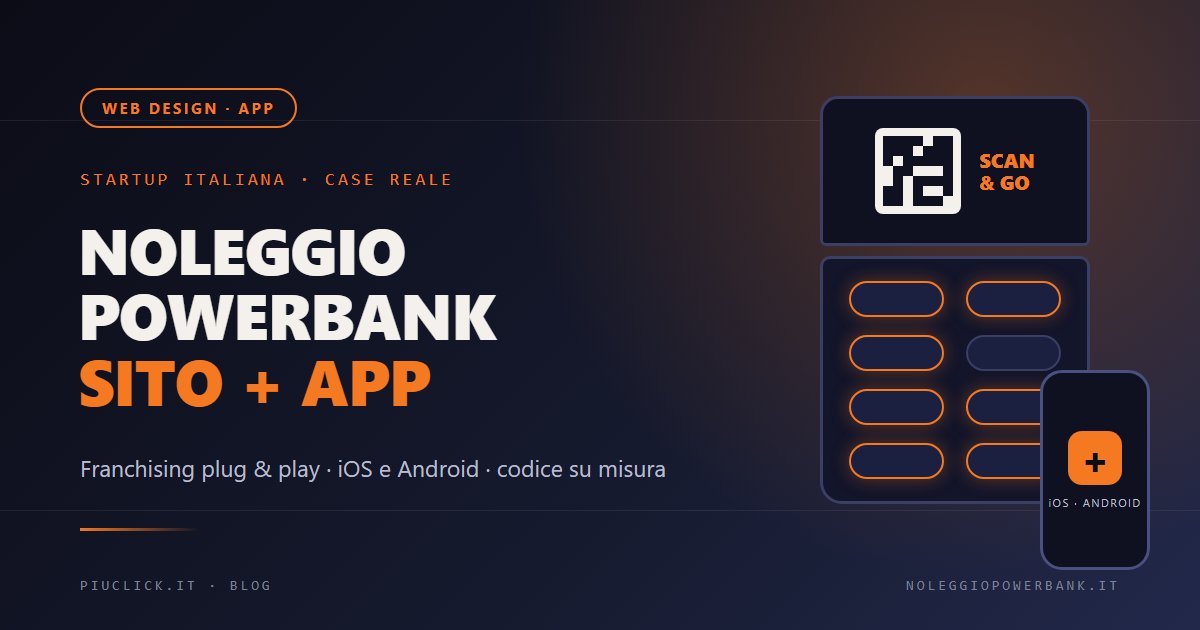
Noleggio Powerbank: website and app for an Italian plug & play franchise startup
We designed and built noleggiopowerbank.it and its iOS and Android app: an Italian plug & play power bank rental startup, a site written from scratch with no external dependencies and a fully in-house contact form.
When a startup is born, the website is not a shop window: it is the company's first salesperson. It has to explain a new business model, answer objections before they are raised and turn a curious visitor into an enquiry. For Noleggio Powerbank we built exactly that: a website and an app presenting a power bank rental franchise designed for people who want to start a business without technical skills.
In this article we walk through the project: what the startup offers, how we set up the site to sell a franchise, why we chose custom code with no external dependencies and how the Apple and Android app came about.
What Noleggio Powerbank is
Noleggio Powerbank is an Italian startup that installs power bank rental stations in bars, hotels, gyms, shops and anywhere people are left with a flat phone. The customer scans the QR code on the station, pays by card, Apple Pay or Google Pay (only a deposit is pre-authorised), takes the most charged power bank and returns it to any station in the network, paying only for the time used. No app needed to rent.
The heart of the offer, though, is the franchise: anyone can open their own network of stations in their area. What sets it apart:
- Plug & play — stations arrive already registered on the platform, with rates and the rental page ready. Plug them in and they are online.
- Direct revenue — the franchisee connects their own payment account and rentals land in their account, not the franchisor's.
- Two revenue streams — each station has a 10.1" screen for selling advertising to local businesses or promoting the venue hosting it.
- Accessible investment — entry from €10,000 + VAT covering stations, power banks, platform activation, training and launch.
- Italian platform — software developed and supported in Italy, with a real-time back office for every station and every battery.
The plug & play model in four steps
A franchise sells on clarity. That is why the site tells the launch in four steps, the same ones that come back on the "How it works" page and in the app:
- Request information — fill in the form; the startup calls, analyses the area and sends the pre-contractual disclosure required by Italian Law 129/2004 on franchising.
- Choose locations — bars, hotels, gyms or shops to host the stations, with materials and a template agreement for host venues.
- Connect your payment account — stations arrive configured; the franchisee only sets up their own payment system.
- Switch on and earn — the station goes online, customers rent from the QR code and the franchisee follows everything from the back office.
The website: designed to sell a franchise
Anyone weighing up a franchise asks the same questions: how much does it cost, how much can I earn, how much work is it, what guarantees are there. We built the site's architecture around those questions, one page each:
- Franchise — what the entry package includes, the advantages of the model and the launch path.
- How it works — the end customer's flow and the franchisee's, with the suggested starting rate (10 free minutes, €2 for the first hour, €1 for each further hour, €5 daily cap).
- Stations — five formats, from the 8-slot Start included in the entry package to touch-screen towers, rainproof outdoor stations, stackable modules and custom walls with 216 slots.
- Earnings — an interactive simulator estimating the monthly margin from stations, rentals and advertising, always with the warning that it is an estimate.
- Sectors — eight dedicated pages (bars and restaurants, hotels, gyms, events and more) explaining why rental works in each setting and where to place the station.
- FAQ and blog — nineteen answers to the most common objections and the first six in-depth guides, from "how much can you earn" to deposit pre-authorisation.
Every page ends with a single action: request information. There are no carts or prices to compare: a franchise closes on a phone call, and the site's job is to bring in that call with a well-informed lead. It is the same principle we apply to every conversion-focused landing page.
Custom code with no external dependencies
The most important technical choice was what not to use. No WordPress, no page builder, no third-party plugins, no subscription CMS. The site is a Next.js application in TypeScript written from scratch, and beyond the framework it uses only three small libraries: one to read blog articles, one to turn them into HTML and one to send the form emails.
It is not purism. For a startup every dependency is a hidden cost:
- Security — every plugin is someone else's code running on your site. Fewer external pieces mean fewer vulnerabilities to chase and fewer updates that break something.
- Speed — pages are generated ahead of time and are lightweight: they open instantly even on a phone, and speed affects both conversions and rankings.
- Cost — no fees for themes, builders or form services. The site costs its hosting and nothing else.
- Ownership — the code belongs to the client. If a new feature is needed tomorrow, it gets written; nobody waits for a vendor to add it to their price list.
All content that appears on several pages (advantages, steps, FAQ, sectors, station formats) lives in a single file and feeds both the pages and the structured data for Google. The blog is made of plain text files: publishing an article needs no admin panel, just a new file. We followed the same philosophy for Appartamenti Mare Sardegna and for the site of La Tavernetta di Cortina, which passed 70,000 organic interactions in a year.
The contact form: all in-house
The "Request information" form is the most important page on the site, which is why we did not hand it to an external service. The code that receives enquiries is ours and does everything itself:
- It collects what is needed to qualify the lead: city, profile (investor, venue owner, existing business), budget and launch timing.
- It validates the data server-side, with length limits and required fields.
- It stops spam without a captcha: a trap field invisible to users, a check on how long the form took to fill in and a limit on submissions per address.
- It sends the enquiry by email from the company mailbox and, when needed, can pass it to a CRM or an automation with a simple setting.
- It records the conversion in Google Analytics only after cookie consent, in line with the GDPR.
The iPhone and Android app
Together with the site we built the Noleggio Powerbank app, with a single React Native codebase for iPhone and Android. Version 1 is deliberately lean and does a few things well:
- Home — an introduction to the project and three paths: open a network, host a station in your venue, simulate earnings.
- Simulator — the same calculation model as the site, with the same warning: it is an estimate, not a promise.
- Request information — the form sends the enquiry to the same system as the site, with the same anti-spam checks, and opens with the profile already chosen on the home screen.
- Info — FAQ, support, app sharing and privacy.
The app asks for no account, no permissions and does not track users: no location, camera or notifications. A privacy choice, but also a pragmatic one: an app that collects nothing unnecessary gets through store review faster and has simple privacy labels. It is already available on Google Play, and App Store release is the next step. We covered Apple's review rules in the Social AI Hub case.
SEO and AI search from day one
A new site starts with zero visibility, so SEO could not wait. From launch, noleggiopowerbank.it has:
- Titles and descriptions written for real Italian searches, such as "franchising noleggio power bank" or "aprire un'attività con 10.000 euro".
- schema.org structured data for the organisation, FAQ, articles and breadcrumbs, generated from the page content itself.
- A sitemap, an RSS feed, preview images generated for every page and an llms.txt file describing the site to AI answer engines.
- A single canonical domain: the .com and www variants redirect permanently to the .it.
- Sector pages and articles answering the questions of people evaluating the franchise: content Google and AI engines can quote.
A growing share of searches now goes through ChatGPT, Gemini and Google's AI Overviews. To get cited you need clear, structured, verifiable content: the work we describe in our guide to Generative Engine Optimization.
What it teaches anyone launching a startup
Noleggio Powerbank is the third product we have taken from idea to market with the same method, after Social AI Hub and Hippolife, the horse-care app that has passed 14,000 registered members since September. And the same approach, proprietary code written from scratch, is how we built the website and internal back office for StockItalia: lot monitoring, pricing, CRM and email sending. The lessons that apply to any new venture:
- Model first, website second — we wrote the product brief and the answers to objections before drawing a single page. The site translates a clear offer; it is not a way to find one.
- Site and app from the same brain — content, simulator and form are shared: update once and it changes everywhere.
- Fewer dependencies, more control — for a startup that has to change fast, being able to edit every line of code is worth more than any ready-made theme.
- Measure from day one — form conversion tracked, cookie consent compliant, leads qualified by budget and timing: the data to make decisions is already there.
A startup has no time to waste on a website that needs chasing, patching and paying for by subscription. For Noleggio Powerbank we wanted the opposite: our own code, fast, ready to grow with the business, and an app that speaks the same language as the site. Anyone thinking of opening a network should understand everything in five minutes and request information in thirty seconds.
— Niccolò Giuseppetti, founder of +Click
Frequently asked questions
What is Noleggio Powerbank?
It is an Italian startup offering a plug & play power bank rental franchise: pre-configured stations to install in bars, hotels, gyms and shops, with rental payments going straight to the franchisee's account. Entry starts at €10,000 + VAT. The official site is noleggiopowerbank.it.
Who built the Noleggio Powerbank website and app?
+Click: design, copy, development of the site in Next.js with custom code, the contact form, SEO and the iPhone and Android app built from a single React Native codebase.
What does a website "with no external dependencies" mean?
That the site does not rely on a CMS, page builder, plugins or third-party services to work: it is code written from scratch, with only three small libraries beyond the framework. The contact form, blog and structured data are handled by the site's own code. The result: more security, faster pages, no subscriptions and full control.
Is the Noleggio Powerbank app available on iPhone?
The app is built for iPhone and Android from the same code. It is already on Google Play, and App Store release is the next step. Renting a power bank does not require any app anyway: just scan the QR code on the station.
How much does a website and app for a startup cost?
It depends on how many pages, features and integrations you need. A custom site with a form, blog and technical SEO plus a lean iOS and Android app built from one codebase costs far less than two separate projects, because content and logic are shared. Our guide to website prices in Italy gives reference figures for each type.
Got a startup or a new business to launch?
We design and build websites, iOS and Android apps and custom back-office software, with code you own and no unnecessary dependencies. Tell us your idea: we will tell you honestly what it takes to start, what it costs and how long it takes, just as we did with Noleggio Powerbank.
Let's talk